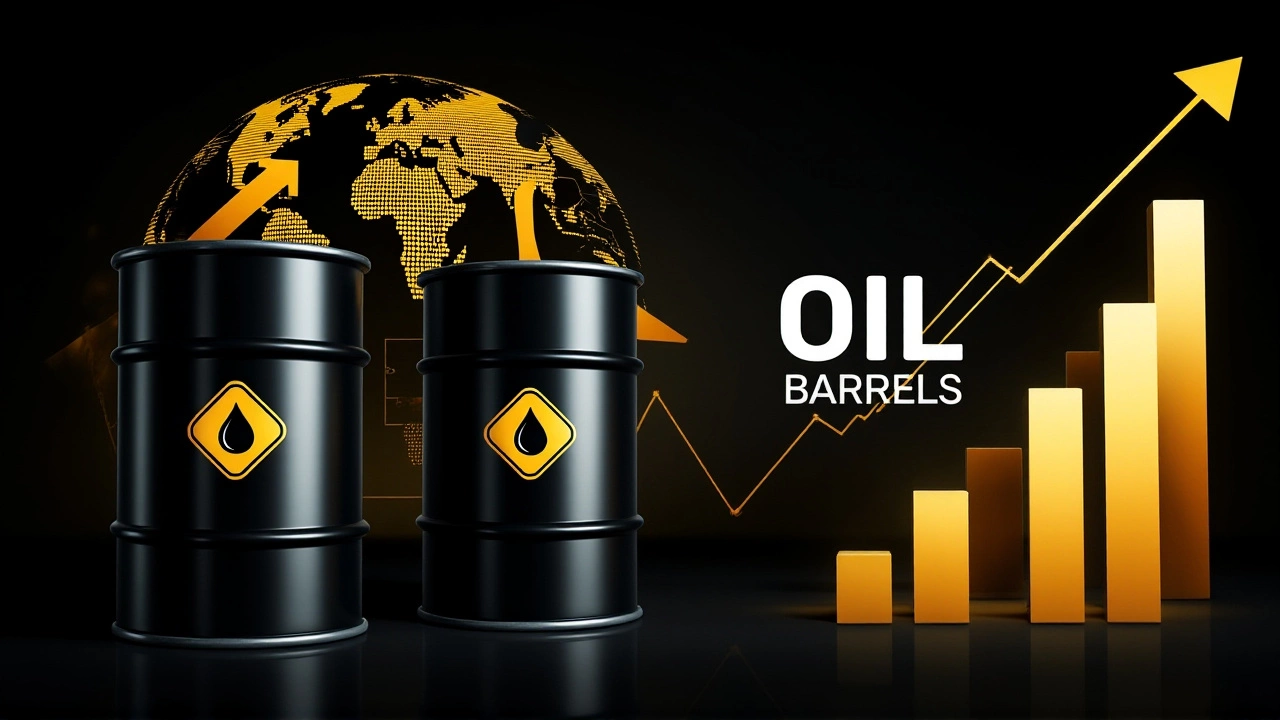
It’s the kind of morning that makes investors reach for their wallets—and hold on tight. Brent Crude, the global benchmark for oil prices, surged past $125 a barrel on Thursday morning. The jump wasn’t just a blip; it was a scream from the market. Why? Because peace talks between the United States and Iran have ground to a halt, casting a long shadow over the Strait of Hormuz.
Here’s the thing: when that narrow waterway gets tense, the world holds its breath. Roughly one-fifth of the world’s oil supply squeezes through there daily. If it stays closed or restricted, prices don’t just tick up—they rocket. And right now, they’re flying.
The Numbers Behind the Panic
Let’s look at the raw data, because the numbers tell a stark story. In early trading on Thursday, June delivery contracts for Brent crude jumped 6.2% to hit $125.36 per barrel. July deliveries weren’t far behind, climbing 3.1% to $113.85.
To put that in perspective, rewind to late February—just before the current conflict escalated. Back then, Brent was hovering around $70 a barrel. That’s a roughly $55 increase in just a few months. It’s not an inflation adjustment; it’s a war premium.
The twist is that this isn’t just about today’s news. It’s about uncertainty. Traders hate two things: volatility and unknowns. Right now, we have both. No one knows if the Strait will reopen next week or next month. That ambiguity is pricing itself into every drop of fuel.
Global Markets Take a Hit
You might think high oil prices are good for energy stocks, but the broader market sees them as a tax on growth. Higher energy costs mean higher transportation costs, which means lower profit margins for everyone else. So, what happened across Asia?
- Japan: The Nikkei 225 dropped 1.6%, closing at 58,967.07.
- South Korea: The KOSPI fell 1.1% to 6,615.51.
- Hong Kong: The Hang Seng Index slid 1.3% to 25,772.50.
- Australia: The S&P/ASX 200 dipped slightly by 0.3% to 8,665.50.
- China: Interestingly, the Shanghai Composite actually rose 0.1% to 4,109.99, showing some resilience despite the gloom.
- India: The Sensex tumbled 1.2%, reflecting local anxiety about import bills and currency pressure.
Wall Street futures followed suit, sliding after weak performance in Asian markets. It’s a domino effect: tension in the Middle East hits oil, oil hits consumer spending, and consumer spending hits corporate earnings.
What Are Experts Saying?
I spoke with several analysts who’ve been watching these charts closely. The consensus? Stay cautious, but don’t panic sell everything.
One key insight comes from a recent official survey regarding China’s factory activity. Despite the energy shock, manufacturing activity slowed in April but remained in expansion territory for the second consecutive month. That’s a glimmer of hope. It suggests that demand hasn’t collapsed yet, even if it’s bruised.
For Indian investors, the advice is nuanced. Analysts suggest that if you have a horizon of at least one year, you might consider allocating 15-20% of your portfolio to oil marketing companies like Bharat Petroleum Corporation Limited (BPCL), Hindustan Petroleum Corporation Limited (HPCL), and Indian Oil Corporation Limited (IOC). Their business won’t stop; in fact, higher margins could help them temporarily.
But wait—don’t ignore other sectors. The pharmaceutical and automobile sectors are seen as relatively protective during turbulent times. Meanwhile, keep a wary eye on IT. There’s still no clarity on global tech spending, so patience is key there. And for the bold? The metal sector, particularly players like Vedanta Limited, might be a “surprise package” given strong recent results.

Why This Matters to You
This isn’t just Wall Street drama. When oil hits $125, your pump price goes up. Your grocery bill goes up (because transport costs rise). And if the Strait of Hormuz remains a chokepoint, these prices could stick around longer than anyone hopes.
The details on when—or if—diplomatic channels will reopen are still unclear. Until then, markets will remain jittery. Investors are betting on stability, but they’re paying a premium for fear.
Frequently Asked Questions
Why did oil prices spike to $125?
The surge is directly linked to stalled peace negotiations between the US and Iran. With tensions rising, fears grew that the Strait of Hormuz—a critical global oil transit point—might remain restricted or closed, threatening global supply chains and driving up prices sharply.
How does this affect the Indian stock market?
High oil prices hurt India’s trade deficit since we import most of our crude. This puts pressure on the rupee and increases inflation. Consequently, indices like the Sensex saw a 1.2% drop. However, domestic oil marketing firms may see short-term margin benefits.
Should I invest in oil stocks now?
Analysts suggest a selective approach. For long-term holders (one year+), allocating 15-20% of your portfolio to major oil marketers like BPCL, HPCL, or IOC could be viable. However, avoid putting all your eggs in one basket; diversify into defensive sectors like pharma and auto.
Is China’s economy immune to this shock?
Not entirely, but it’s resilient. Official surveys show Chinese factory activity slowed in April but stayed in expansion territory for the second month straight. This indicates that while energy costs are biting, industrial demand hasn’t collapsed.
When will prices stabilize?
There is no fixed timeline. Stabilization depends entirely on diplomatic breakthroughs between Washington and Tehran and the reopening of the Strait of Hormuz. Until certainty returns, expect continued volatility in energy and equity markets.